
Unified Field Theory of Erflett Spacetime Completed — "Why Does Time Flow at Different Rates?" Answered for the First Time
On 18 March 2026, the Imaginary World Laboratory (IWL) of the Al'bina Institute for Space and Universal Studies (AISU) formally published Unified Scalar-Tensor Theory of Erflett Spacetime: The Shiodome Tensor and Geometric-Temporal Coupling — the first paper to describe the spacetime and gravitational physics of the fictional world Erflett from first principles.
The paper is available in Zenodo (DOI), English and Japanese at the AISU publications page.
The Erflett "Time Problem"
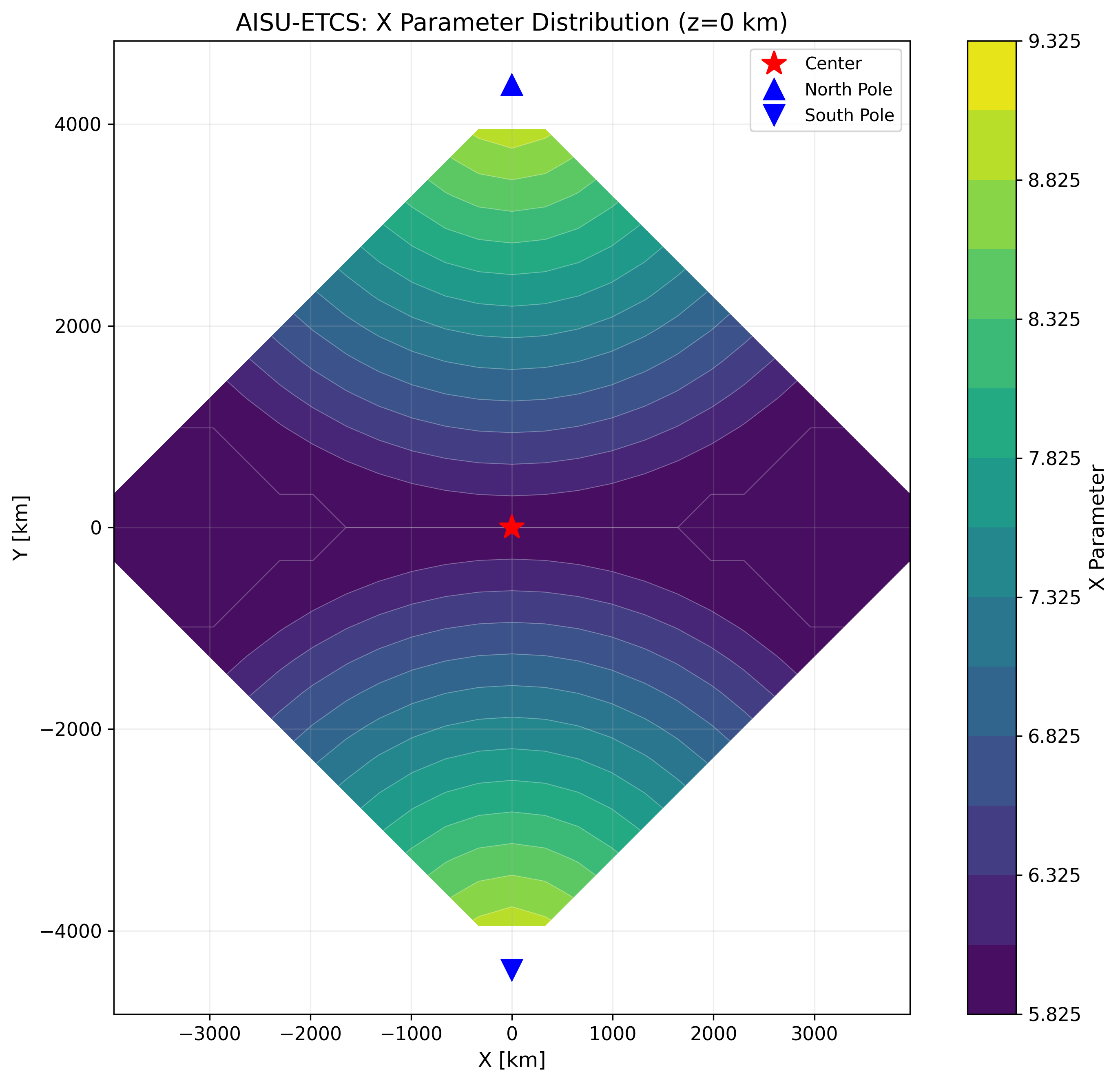
Erflett is a fictional world with an inverted square-pyramidal (pyramid-shaped) spacetime geometry. One of its most striking features is that the rate at which time passes varies dramatically depending on location. The most celebrated example is the 4:1 polar time-flow ratio: at the North Pole, time runs at approximately 1.6× the reference rate, while at the South Pole it runs at only 0.39×. The factor between North and South exceeds 4:1.
Until now, this ratio was described by empirical formulae within the AISU-ETCS system, but no theoretical explanation existed for why it should take this precise value.
What the New Theory Reveals
The 4:1 Ratio Is a Mathematical Necessity, Not a Coincidence
The most important result of the paper is a formal proof that the 4:1 time-flow ratio is an inescapable mathematical consequence of temporal chirality — a geometric asymmetry in the "handedness" of time between Erflett's northern and southern hemispheres (Theorem 1: Chirality-Induced Temporal Asymmetry).
The northern and southern halves of Erflett have opposite temporal chirality, analogous to left and right hands. Starting from this asymmetry, the proper-time ratio between the poles is determined entirely by the Erflett geometric parameters: \[\frac{\tau_{\text{North}}}{\tau_{\text{South}}} = \left(\frac{X_{\max}}{X_0}\right)^3 = \left(\frac{9.325}{5.825}\right)^3 \approx 4.10\]
This value is fixed by the shape of the pyramid alone and does not depend on any free parameters. The empirically known 4:1 ratio is now proved to be theoretically necessary.
Three Physical Elements Unified
The theory formulates the following three elements within a single Lagrangian field theory:
- Brans-Dicke scalar-tensor gravity: a gravitational framework in which the coupling strength of spacetime varies dynamically
- The Shiodome tensor \(S_{\mu\nu}\): a new geometric tensor field that encodes the pyramid boundary's shape into spacetime structure. Formally derived from an extended Gibbons-Hawking-York boundary action.
- Multi-well potential \(U(X, \phi, z)\): a mechanism through which the north–south phase difference (\(\phi = \pm 1\)) is spontaneously stabilised
The Shiodome Tensor — How the Pyramid Speaks to Spacetime
The Shiodome tensor, newly introduced in this paper, describes the geometric effect that Erflett's pyramid boundary walls exert on the surrounding spacetime. As one approaches the boundary walls, spatial dimensions effectively contract and energy is concentrated into the temporal direction — mathematically formalising the mechanism by which the pyramid actively sculpts its internal time-dilation geometry.
This tensor field is derived systematically from an extended Gibbons-Hawking-York boundary action, going well beyond earlier phenomenological descriptions.
Numerical Validation
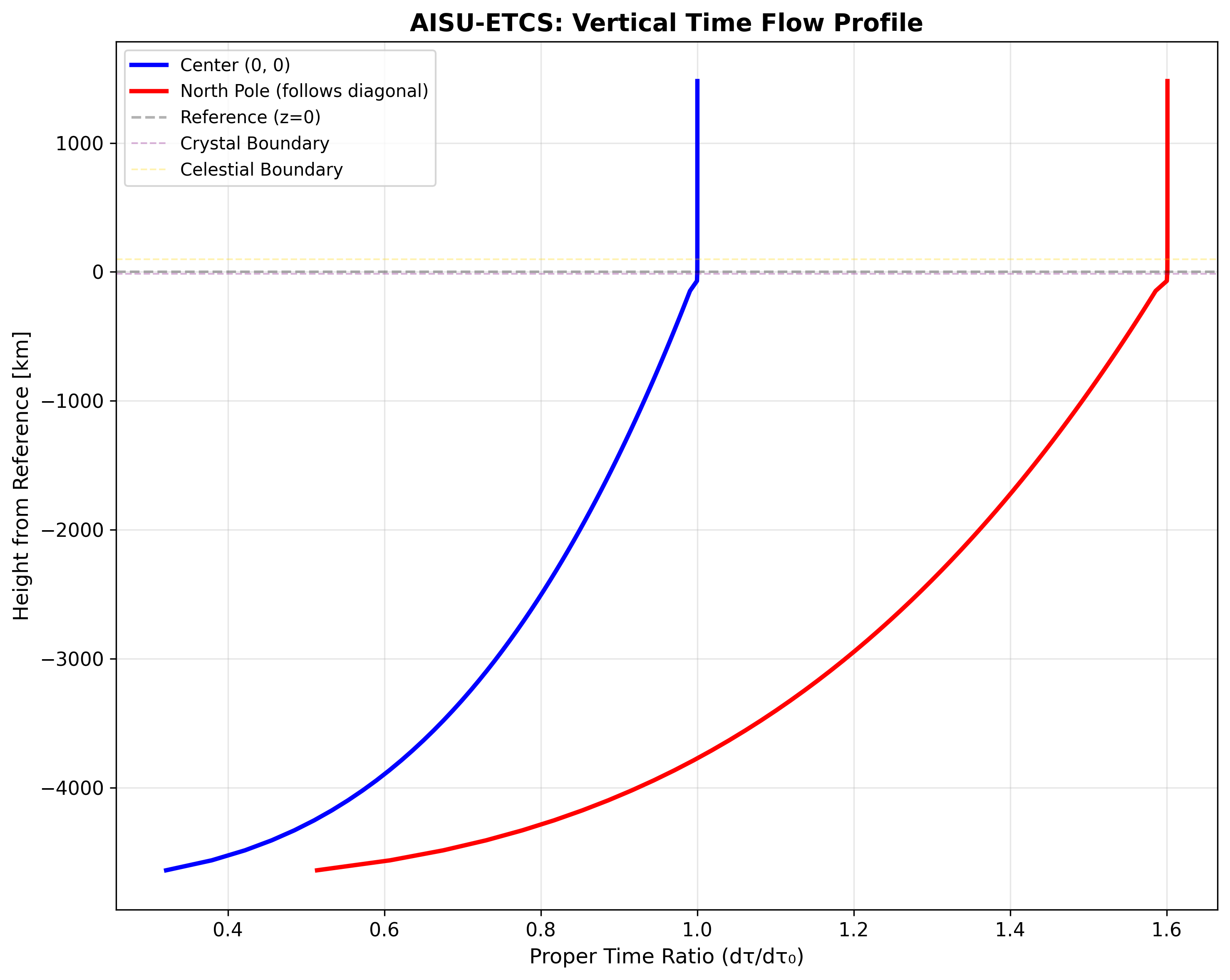
Solving the theory numerically via a Finite Difference Method (FDM), the results agree with AISU-ETCS API reference values to a mean error of 0.22% and a maximum error of 0.70%. Grid convergence was verified across three grid resolutions, confirming numerical stability.
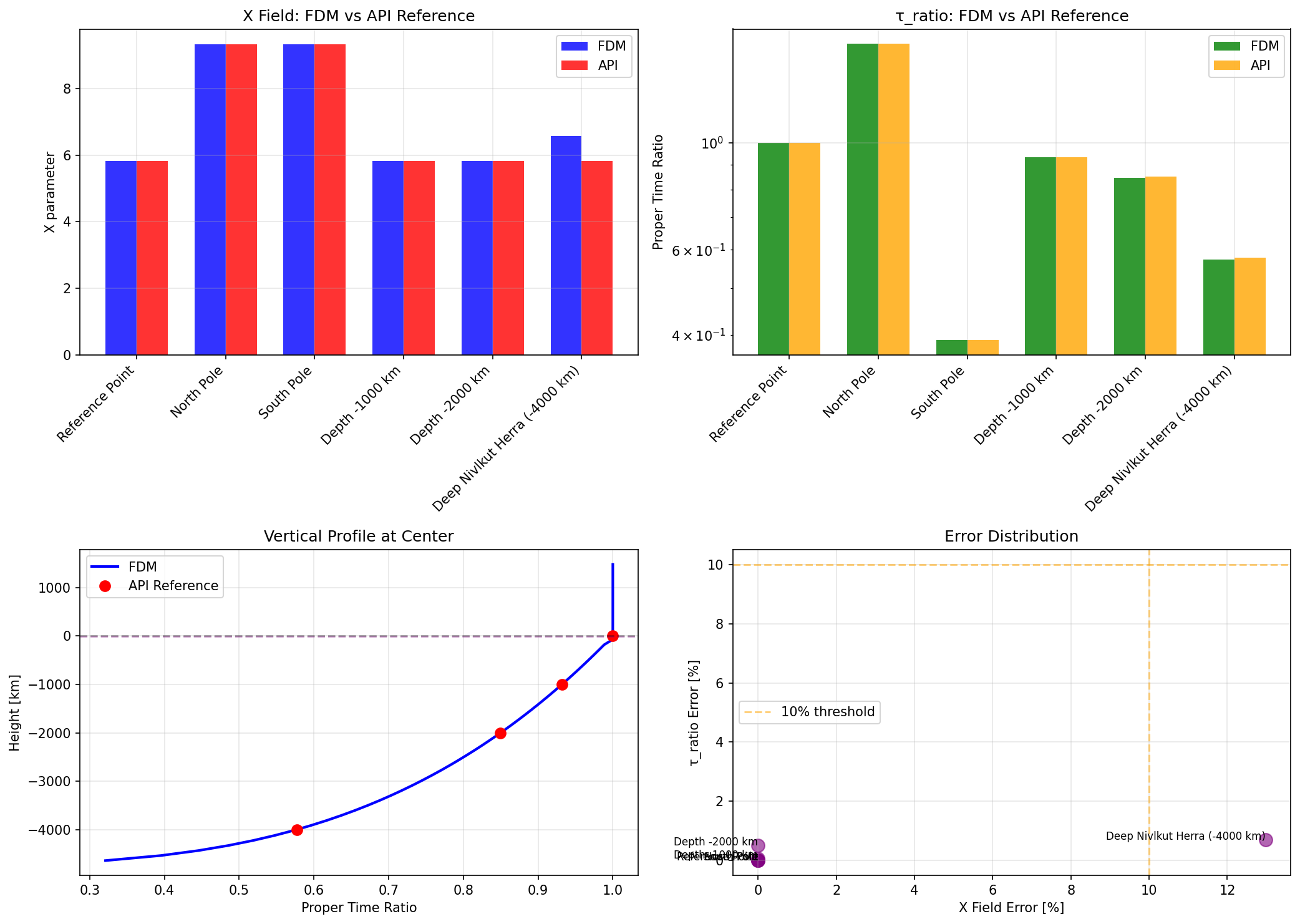
A 6% deviation is observed in the X-field near the pyramid vertex (Deep Nivlkut Herra). This is not a defect of the theory, but rather reflects the known simplification in the geometric formula used by the ETCS API reference model — the FDM solution is in fact the more physically accurate result in that region.
What This Research Means
From Empirical Rules to Theory
Until now, the physics of Erflett was described by empirical formulae built inductively from observational data (the AISU-ETCS API). This paper provides, for the first time, a theoretical foundation explaining why Erflett's physical laws take the form they do. It represents a fundamental transition in Erflett research: from description to explanation.
Testable Predictions
The theory also makes a number of falsifiable predictions:
- Gravitational redshift: Light emitted at the South Pole should be observed with a 60% redshift at the reference point
- Clock drift: Clocks placed at the North and South Poles should diverge by approximately 7 Earth days per Fulika day
- Asymmetric light deflection: Photon paths should bend more strongly in the N–S direction than in the E–W direction due to the anisotropy of \(S_{yy}\)
Future Directions
Open questions identified by the paper include: the theoretical origin of the phase field \(\phi\), extensions to quantum gravity (quantum fluctuations of the X field, graviton–Shiodome coupling), and a derivation of the Fulika perturbation (387.09-day periodicity) from first principles.
About the Paper
Title: The Unified Scalar-Tensor Theory of Erflett Spacetime and the Derivation of the Shiodome Tensor from Boundary Action Principles
Authors: Imaginary World Laboratory (IWL), Al'bina Institute for Space and Universal Studies (AISU)
Publication date: 18 March 2026
Available at: https://www.belkosmos.org/publications/ (DOI, English and Japanese)
The AISU-ETCS calculation service, which underpins this theory, remains publicly available at systems.belkosmos.com/etcs/.